Your kitchen fire is already out, or smoke rolled in from a neighbor’s apartment, or a brush fire miles away pushed haze through your vents, and every room still smells like a campground. For smoke damage in Houston, call BIONIC Emergency Services at (713) 338-2424. The line is answered 24/7, the company holds a 4.9-star Google rating across 156 reviews, and its technicians carry IICRC Water Restoration Technician (WRT) and Applied Structural Drying (ASD) credentials to manage cleanup from the first call through the final odor check.
Do I need to call 911 before calling anyone else?
Call 911 first only if something is still smoldering, sparking, or you smell gas. A fire department needs to clear an active hazard before anyone, including a restoration crew, goes back in.
If the fire is already out, the embers are cold, and the only problem left is smoke, soot, and odor, you can skip straight to the insurer and a smoke damage restoration company. That covers most of what actually brings people to this question: a grease fire that stayed in the pan, an appliance or outlet that smoked but never flamed, smoke that drifted in from a neighboring unit, or haze from a brush or industrial fire that got pulled into the house through the HVAC system. None of those need a full structure-fire response, but all of them leave behind soot and odor that get worse the longer they sit.
If your situation is closer to an actual house fire, where a room or an attached structure actually burned, start with Who to Call After a House Fire in Houston instead; that post covers the bigger version of this same decision tree.
What order should I call people in after a smoke-only event?
The order is fire department (only if something is still active), then your insurance company to open the claim, then a smoke damage restoration company, before you wipe down a single wall.
That last point matters more than it sounds. Soot is made of fine, often oily particles that smear and grind into porous surfaces the moment a rag touches them. A bungalow near The Heights with a stovetop fire contained to the pan can still end up with soot driven two rooms away just from someone trying to clean it with dish soap and a sponge before a professional ever saw it. Protein residue, the kind a grease or meat fire leaves behind, is often close to invisible on painted surfaces but carries a strong, sour odor that ordinary cleaners don’t touch. A crew trained to the ANSI/IICRC S700 fire and smoke restoration standard identifies which kind of residue is present before choosing a cleaning method, because the wrong method sets the stain instead of lifting it.
Electrical and appliance smoke-outs follow the same order. So does smoke intrusion from a neighboring unit, a common call in denser pockets around Montrose and Midtown where units share HVAC returns or attic space; your policy and your neighbor’s may both come into play, so get the claim open early even though the fire happened in someone else’s unit. For haze from a nearby brush or industrial fire, note that wildfire smoke affects indoor air quality even without a flame anywhere near the property, which is why odor and air-quality complaints after an outdoor smoke event are a real, often insurable, loss, not something to just air out and wait on.
What actually happens when you call a smoke damage restoration company?
A first call takes inventory: the kind of fire, how long the smoke sat, which rooms and systems it reached, and where you are in the insurance process. Have your address, a rough timeline, and your insurer’s name ready; that alone usually gets a same-day assessment on the calendar.
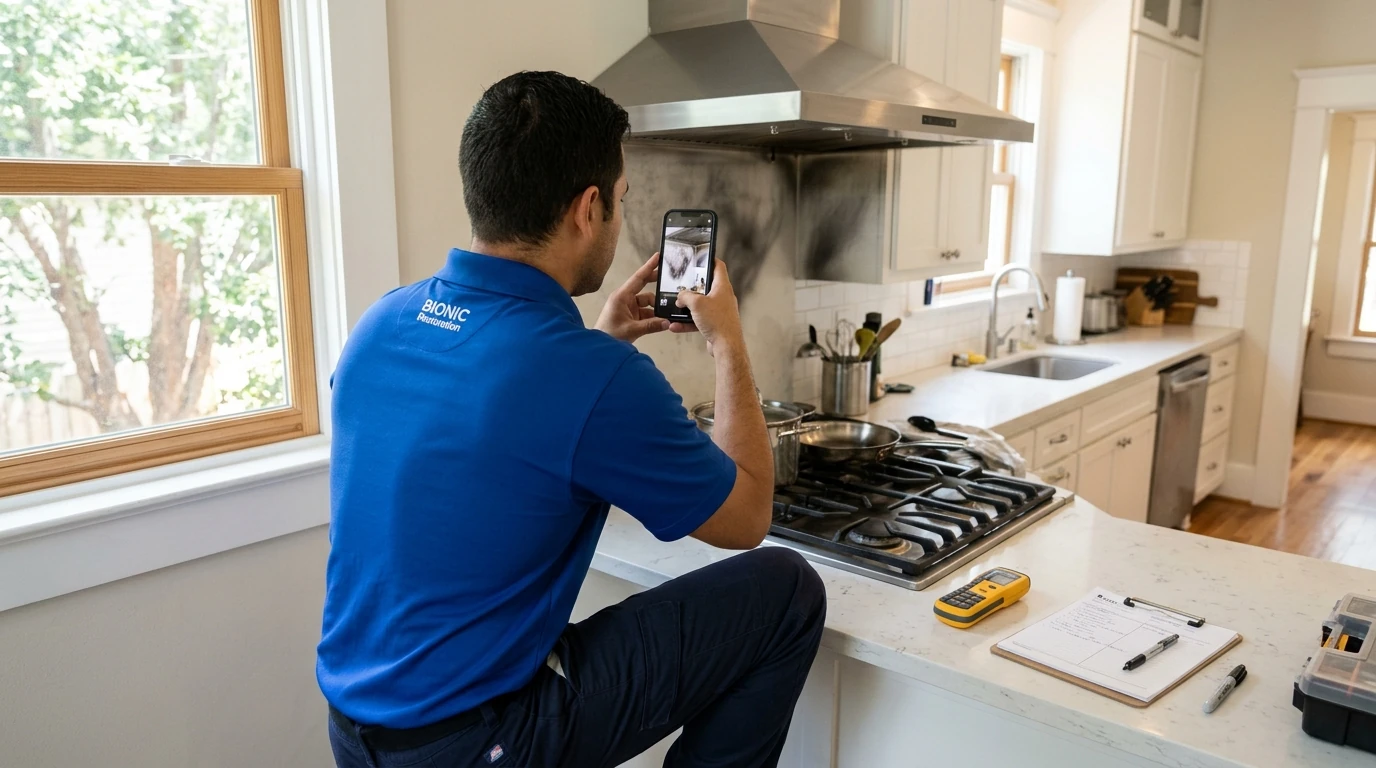
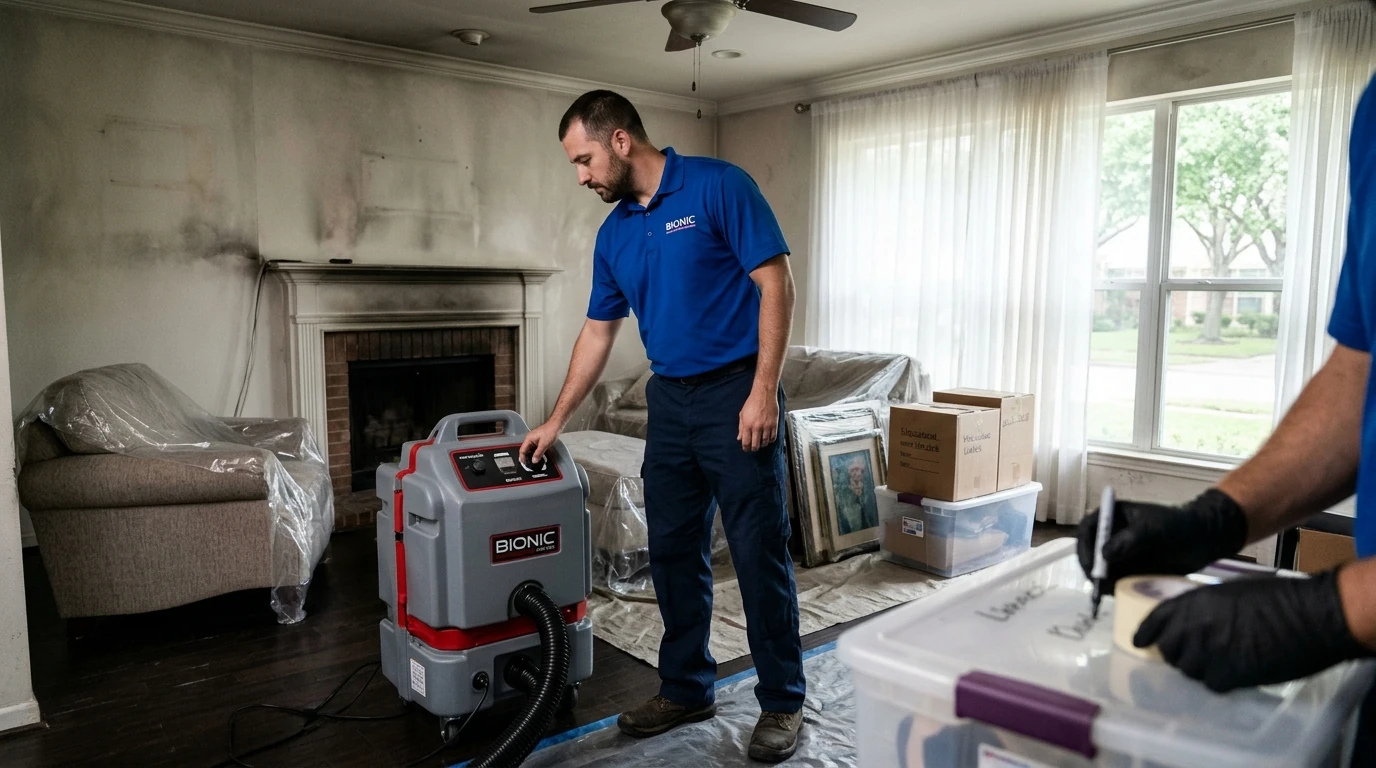
On arrival, a technician walks the property before touching anything, photographing soot patterns, checking the HVAC system (a major path for smoke to spread into rooms that never saw flame), and testing surfaces to identify residue type. That documentation protects your claim as much as it guides the cleaning plan. Only after that assessment does cleaning start, usually HEPA air scrubbing first to pull particulate out of the air, then surface cleaning matched to the residue type, then odor treatment. The full smoke damage restoration process and timeline is covered in more depth on our service page, and if smoke reached framing, drywall, or insulation, that work can overlap with fire damage restoration even when the flame itself stayed small.
What should I throw away, and what can actually be saved?
Throw away anything porous that absorbed heavy smoke and can’t be fully cleaned: exposed food, opened medicine and cosmetics, and any heavily sooted item already near the end of its useful life, like old bedding or worn upholstery. Hold onto everything else until a professional has had a chance to assess it, because a surprising amount of what looks ruined isn’t.
Hard-surface contents like electronics, dishware, furniture frames, and most clothing are usually salvageable through a proper contents cleaning process: ultrasonic cleaning for small items, ozone or hydroxyl treatment for odor, specialized laundering for fabrics, often at a fraction of replacement cost. That’s what contents restoration and storage is for: pack-out, clean, deodorize, and return, instead of a blanket toss-it-all decision made under stress.
On the clothing question specifically: light, surface-level smoke exposure often comes out in a normal wash with an extra rinse cycle. Heavy soot or protein smoke odor usually doesn’t; home washing can set the smell into the fibers instead of removing it, the same reason wiping down walls yourself backfires. If the smell is still there after one wash, stop and let a professional handle the rest rather than running it through the dryer and locking the odor in for good. For a deeper look at why DIY odor removal usually falls short, see How Professionals Remove Smoke Odor.
If you’re unsure where your situation falls, filing the claim is still worth doing early. The Texas Department of Insurance publishes consumer guidance on disaster-related claims, and most Houston homeowners policies treat sudden fire and smoke damage, including smoke that drifted in from outside the home, as a covered event, though every policy and insurer differs on specifics.
Smoke-only damage is easy to underestimate because there’s no charred room to point to, just a smell and a gray film that keeps reappearing no matter how many times you wipe it down. Call BIONIC Emergency Services at (713) 338-2424 before you clean, or request an assessment through the contact page; either way, get documentation started before the claim and the cleanup end up fighting each other.
About BIONIC Emergency Services
BIONIC Emergency Services has served the Houston area since 2011, with technicians holding IICRC Water Restoration Technician (WRT) and Applied Structural Drying (ASD) certifications. The company is insured, answers calls 24/7, and holds a 4.9-star Google rating across 156 reviews. Its crews handle smoke damage restoration, fire damage restoration, contents restoration and storage, sewage cleanup, storm damage restoration, and water damage restoration across Houston and surrounding communities including Pasadena, Pearland, Sugar Land, and The Woodlands.